
Entitlement: The Blind Spot We Rarely See
Bud Heintz
"Entitled" is one of those words we almost never use to describe ourselves.It's a label that tends to be applied by others.Most people don't wake up thinking, I deserve special treatment. Instead,...
"Entitled" is one of those words we almost never use to describe ourselves.
It's a label that tends to be applied by others.
Most people don't wake up thinking, I deserve special treatment. Instead, entitlement often shows up in a much subtler way. It emerges when we expect the future to look like the past, even though the circumstances that created that reality have changed.
In that sense, entitlement is less about arrogance and more about assumption.
It's the belief that the way things are is simply the way things should continue to be.
The Water We Swim In
One reason entitlement can be difficult to recognize is that many benefits become invisible over time.
When something has been part of our lives for years or decades, we stop seeing it as a benefit and begin seeing it as normal. We adapt to it. We build our plans around it. We assume it will continue.
This is where a blind spot can develop.
The challenge is not whether we appreciate something. The challenge is whether we recognize that it was a benefit to begin with.
If we don't, we may fail to prepare for a future in which that benefit no longer exists.
When Benefits Become Expectations
Consider an employee who receives employer-sponsored health insurance for thirty years.
The employee may intellectually understand that the employer is paying a substantial portion of the premium. Yet after decades, the health coverage can begin to feel less like a benefit and more like a natural part of life.
Then retirement arrives.
Suddenly, the employer contribution disappears.
Health insurance hasn't changed. The employee's needs haven't changed. But the arrangement that made the benefit possible has changed.
The question becomes: Did the employee view the insurance as part of their total compensation package, or did they unconsciously begin to think of it as something they simply had?
The answer matters because it affects how they prepare for retirement. Those who understand the value of the benefit are more likely to plan for its eventual loss. Those who don't may be surprised by the cost and complexity of replacing it.
One observation I've made over the years is that people will sometimes decide a service or benefit has become "too expensive" only after they are asked to pay for it themselves.
Yet in many cases, the cost didn't suddenly increase.
The cost was always there.
What changed was who was paying for it.
An employer may have absorbed the majority of a health insurance premium. A university may have funded retirement benefits. An organization may have provided services, support, or resources whose costs were largely hidden from the recipient.
When that subsidy disappears, people often experience sticker shock. Some even choose to go without the service entirely because it now feels unaffordable.
But the reality is that the service was never free. Someone else was simply paying the bill.
This distinction matters because it reveals how easily a benefit can become mistaken for an inherent feature of life. Once we recognize the true cost, we can make more informed decisions about what is worth paying for and what role that benefit plays in our future plans.
When the Benefit Is Visible but the Cost Is Hidden
A similar dynamic can occur with retirement income and benefit programs that were established decades ago.
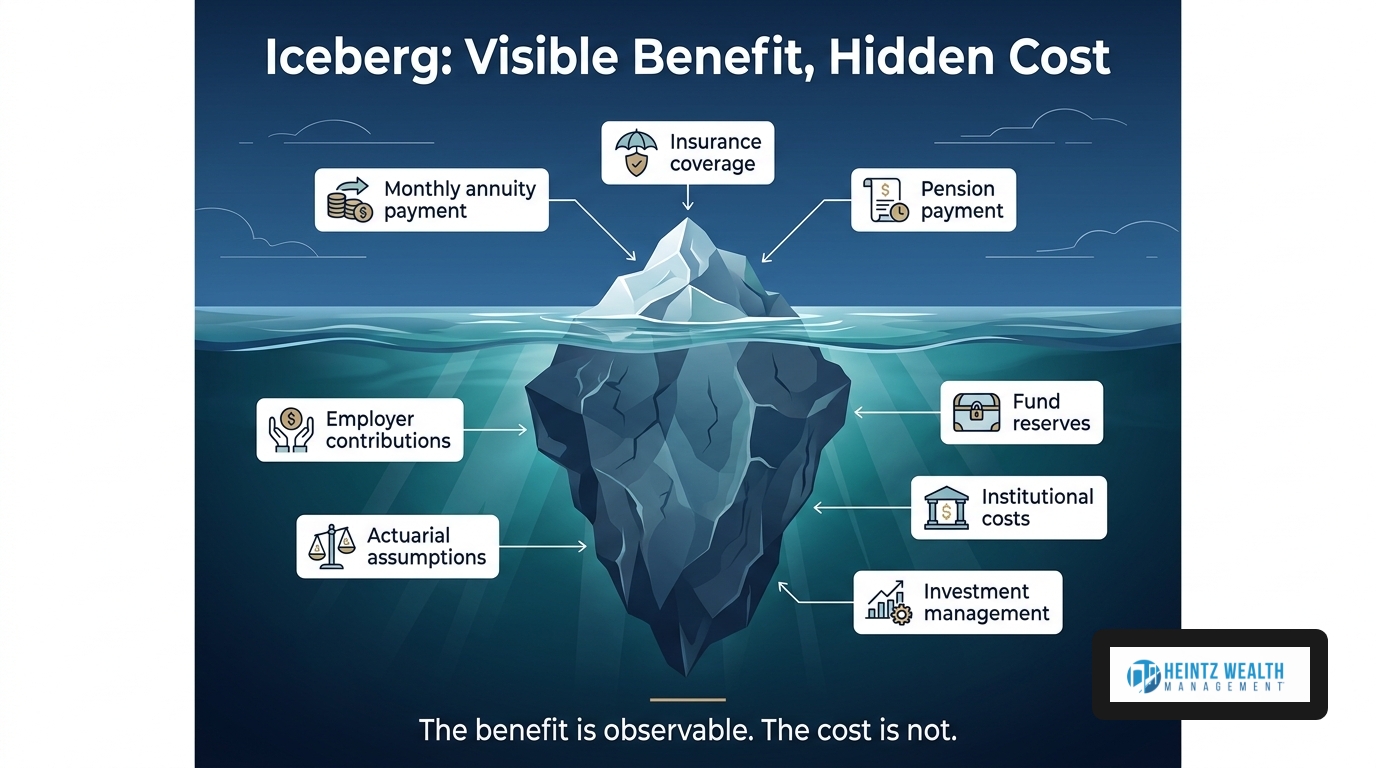
Consider charitable gift annuities or other pension-like arrangements offered through universities, hospitals, charities, and large institutions. In earlier generations, many organizations managed these obligations internally. Participants often had little visibility into the underlying costs, reserves, investment management, or actuarial assumptions needed to support the promised payments.
What participants experienced was simple: a monthly check arrived.
The same dynamic existed with many employee benefits. Workers saw their insurance card, their benefit statement, or the annuity payment deposited into their account. What they experienced was the outcome.
What remained largely invisible was the cost.
The true price of providing those benefits was often absorbed by the institution, spread across budgets, or managed behind the scenes. As a result, the recipient's attention naturally focused on the value received rather than the economic burden required to deliver it.
Over time, a monthly annuity payment, employer-sponsored health insurance, or subsidized retiree benefit can become part of the normal scenery of life. The benefit is experienced repeatedly, while the costs remain hidden.
This can create a planning blind spot.
When people evaluate their future, they may focus on the benefit continuing rather than understanding the structure that makes the benefit possible. If that structure changes, whether because of retirement, a career transition, financial pressure on the institution, or changes in policy, expectations may no longer align with reality.
The issue isn't a lack of gratitude.
More often, it's a lack of awareness.
We naturally focus on outcomes we can see and experience while overlooking the costs and commitments being carried by someone else.
Benefits Versus Rights
One of the most important distinctions in financial planning is understanding the difference between a benefit and a right.
Rights are generally not dependent on the continued generosity, policies, employment, or decisions of another party.
Benefits often are.
Benefits can be modified, discontinued, replaced, or conditioned upon circumstances.
When we confuse benefits with rights, we increase the risk of disappointment and poor planning decisions.
More importantly, we reduce our ability to adapt when circumstances change.
Preparing for the Future Requires Awareness
Good planning starts with asking uncomfortable questions:
- What benefits am I currently receiving?
- Who is paying for them?
- Under what conditions do they continue?
- What would happen if they ended tomorrow?
- Have I accounted for that possibility in my long-term plan?
These questions aren't pessimistic.
They're practical.
The goal is not to eliminate expectations. The goal is to become aware of them.
A Different Way to Think About Entitlement
Perhaps entitlement is not primarily a character flaw.
Perhaps it is better understood as a planning blind spot.
It occurs when we stop seeing the structures, institutions, employers, organizations, and people that make certain benefits possible. Over time, those benefits become part of the background of life, and we begin to assume they will always be there.
The most financially resilient people aren't necessarily those with the greatest resources.
They're often the people who understand the difference between what they have earned, what they have been given, and what might eventually change.
That awareness creates gratitude in the present and preparedness for the future.
And both are valuable assets.
The lesson is not that people should expect less. Rather, they should strive to see more clearly. Every benefit has a source. Every arrangement has a cost. Every system that provides value depends on someone, somewhere, bearing that burden.
Navigate
About the Author
Bud Heintz
Bud Heintz, CFP®, RLP® is the founder of Heintz Wealth Management, a fee-only financial planning and investment management firm serving Scottsdale, Phoenix, and clients nationwide. His approach combines financial planning with life planning principles, helping clients align their money with the life they want to build.
Bud works directly with clients through every stage of the planning process, providing personalized guidance focused on clarity, long-term relationships, and thoughtful decision-making.