
Could One of the Best Retirement Planning Tools Be Hiding in Plain Sight?
Bud Heintz
If I told you there was an account that could potentially reduce your taxes today, grow tax-deferred, and allow tax-free withdrawals in the future, would you want to know more?Most people...
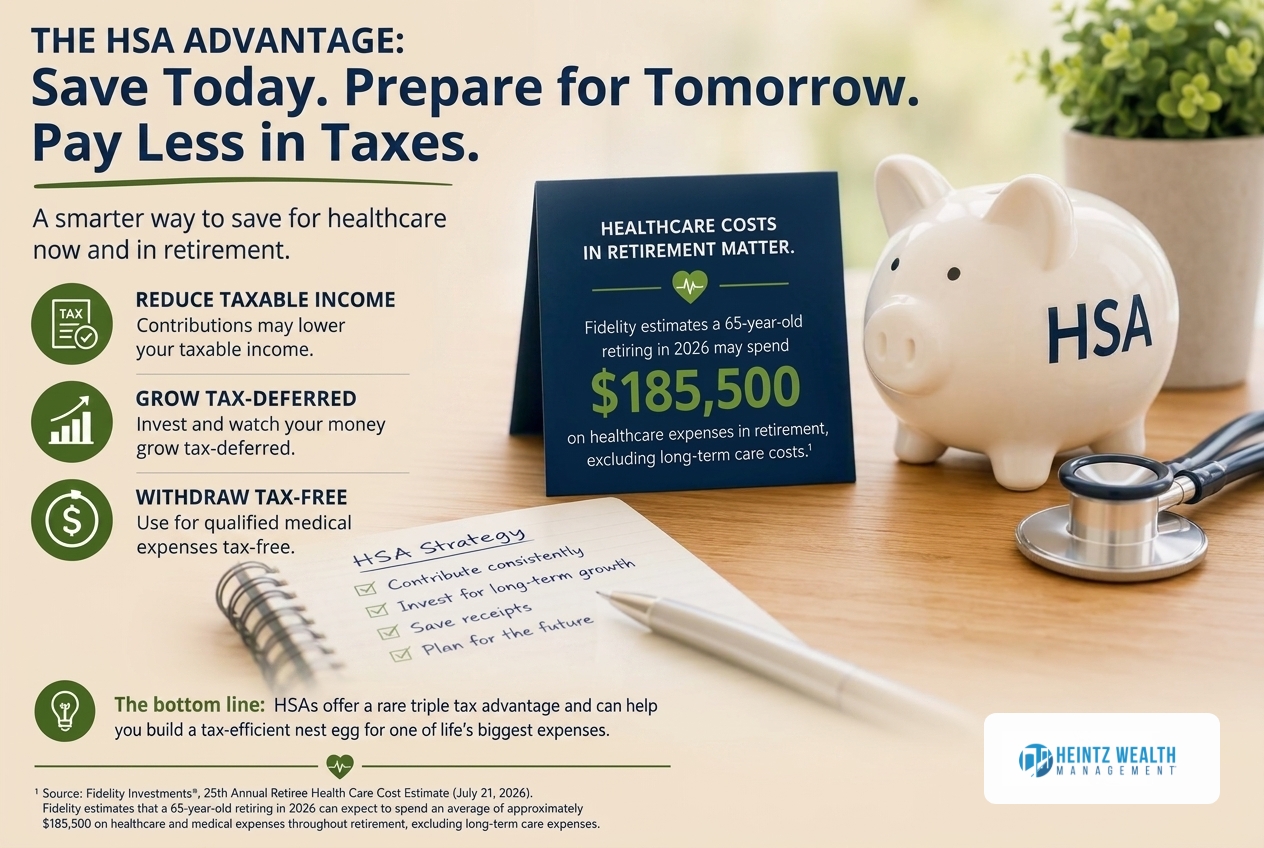
If I told you there was an account that could potentially reduce your taxes today, grow tax-deferred, and allow tax-free withdrawals in the future, would you want to know more?
Most people immediately think of a Roth IRA or a workplace retirement plan. While those are excellent planning tools, there is another account that often flies under the radar: the Health Savings Account, or HSA.
And here's why I think it deserves your attention.
According to Fidelity's Retiree Health Care Cost Estimate, a typical retiree can expect to spend approximately $185,500
on healthcare and medical expenses throughout retirement, excluding long-term care costs. That estimate includes Medicare premiums, deductibles, copayments, and other out-of-pocket healthcare expenses that retirees commonly face.
Think about that for a moment.
Most people spend years saving for retirement, but many have no dedicated plan for managing healthcare costs that could approach $200,000 or more over their lifetime.
That's why I believe the HSA may be one of the most powerful and underutilized financial planning tools available today.
First, Let's Clear Up a Common Misunderstanding
One of the biggest misconceptions I encounter is that people confuse a Health Savings Account (HSA) with a Flexible Spending Account (FSA).
They're not the same thing.
With a traditional FSA, you typically face some version of a "use it or lose it" rule, meaning unused funds may not carry forward indefinitely.
An HSA works differently.
The money is yours. If you don't spend it this year, it stays in the account. If you don't spend it next year, it stays there too. In fact, it can continue growing for years or even decades.
That's one reason I encourage clients to think of an HSA as a long-term asset rather than simply a healthcare spending account.
Why Financial Planners Love HSAs
The real magic of an HSA lies in its tax treatment.
Many financial professionals refer to it as having a "triple tax advantage."
Contributions Can Reduce Your Taxable Income
When you contribute to an HSA, those dollars generally reduce your taxable income, either through payroll deductions or tax deductions, depending on how contributions are made.
The Money Can Grow Tax-Deferred
Just like an IRA or workplace retirement plan, investments inside the HSA can grow without annual taxation on dividends, interest, or capital gains.
Qualified Withdrawals Are Tax-Free
As long as you're using the funds for qualified medical expenses, withdrawals generally come out tax-free.
That combination is extremely rare.
Many accounts offer one tax benefit. Some offer two. An HSA potentially offers all three. Fidelity identifies these same features as the primary tax advantages of an HSA.
You're Not Necessarily Limited to the HSA Your Employer Offers
Another common question I receive is:
“Do I have to keep my HSA where my employer sends my contributions?”
Not necessarily.
While many employers direct payroll contributions to a specific HSA provider, HSAs can generally be maintained with qualified custodians, and transfers between HSA custodians are permitted under IRS rules.
Why does this matter?
Because not all HSA providers offer the same benefits.
Some may offer:
- Better investment choices
- Lower fees
- Better online tools
- More flexibility
- Professional management
Just because your employer selected one provider doesn't automatically mean it's the best choice for your long-term planning needs.
The Strategy Most People Miss
This is where things start getting interesting.
Let's say you incur a $500 medical expense.
Most people pull out their HSA debit card, pay the bill, and move on.
That's perfectly fine.
But if your cash flow allows, there may be another approach worth considering.
Instead of using the HSA, you pay the bill from your checking account and save the receipt.
Why?
Because qualified medical expenses incurred after the HSA is established may generally be reimbursed later, provided you've maintained adequate documentation.
In other words, you could potentially pay a medical expense today, save the receipt, allow your HSA investments to continue growing, and reimburse yourself years later.
The key is recordkeeping.
I encourage clients who utilize this strategy to keep:
- Receipts
- Invoices
- Explanation of Benefits (EOBs)
- Proof of payment
The documentation is every bit as important as the investment account itself.
Think of an HSA as a Healthcare Retirement Account
Most HSA providers allow investment options once certain minimum cash balances are met.
Depending on the custodian, you may be able to invest in:
- Mutual funds
- ETFs
- Diversified portfolios
That's why I often describe an HSA as a healthcare retirement account.
After all, if Fidelity estimates that the average retiree may spend approximately $185,000 on healthcare during retirement, doesn't it make sense to have an account designed specifically to help fund those expenses?
For many people, the HSA becomes less about today's doctor's visit and more about tomorrow's retirement plan.
Frequently Asked Question: What Happens If My Employer Contributes to My HSA?
Q: My employer contributes to my HSA. What happens if I want to open an HSA with my advisor instead?
A: This is one of the most common questions I receive.
Many employers contribute directly to an HSA or offer matching contributions when employees contribute through payroll deductions. In most cases, those contributions are deposited into the HSA provider selected by the employer.
That doesn't necessarily mean you have to leave the money there forever.
Many individuals continue receiving payroll deductions and employer contributions into the employer-sponsored HSA and periodically transfer funds to another HSA custodian that may offer better investment options, lower fees, or professional management.
Before making changes, consider asking:
- Will employer contributions continue if I use another HSA provider?
- Are payroll deductions required to flow through the employer's HSA provider?
- Are there transfer fees?
- Does the current HSA offer the investment options I want?
- Would professional management provide additional value?
In many situations, the answer isn't choosing one account or the other.
It may be continuing to receive payroll and employer contributions in the company-sponsored HSA while periodically moving assets to another provider for long-term investment management.
One important reminder: employer contributions generally count toward your annual HSA contribution limit, so it's important to coordinate all contributions carefully.
My Take
If you're eligible for an HSA, I believe it's worth thinking of it as more than a way to pay this year's medical bills.
A good HSA strategy might include:
- Taking advantage of employer contributions.
- Contributing consistently.
- Investing for long-term growth.
- Saving healthcare receipts.
- Maintaining good records.
- Periodically reviewing whether your current HSA provider is the best fit for your needs.
For many families, an HSA can quietly become one of the most tax-efficient accounts they own.
It's not flashy.
It doesn't get much attention in the financial media.
But when you combine potential tax savings, long-term investment growth, and a future expense that nearly all retirees will face, it deserves a place in the conversation.
And perhaps a larger role in your financial plan than it's currently getting.
Important Disclosure
This article is for educational purposes only and should not be construed as tax, legal, or investment advice. Eligibility for an HSA depends on meeting IRS requirements, including enrollment in a qualifying high-deductible health plan. Tax laws and regulations can change, and individual circumstances vary. Consult your tax professional and financial advisor regarding your specific situation before implementing any strategy. Investments involve risk, including possible loss of principal. Future reimbursement strategies require adequate documentation and compliance with applicable IRS rules.
Source
Fidelity Investments®, Retiree Health Care Cost Estimate. Fidelity estimates that a typical retiree can expect to spend an average of approximately $185,000 on healthcare and medical expenses throughout retirement, excluding long-term care expenses. Source: Fidelity Investments Newsroom.
Navigate
About the Author
Bud Heintz
Bud Heintz, CFP®, RLP® is the founder of Heintz Wealth Management, a fee-only financial planning and investment management firm serving Scottsdale, Phoenix, and clients nationwide. His approach combines financial planning with life planning principles, helping clients align their money with the life they want to build.
Bud works directly with clients through every stage of the planning process, providing personalized guidance focused on clarity, long-term relationships, and thoughtful decision-making.